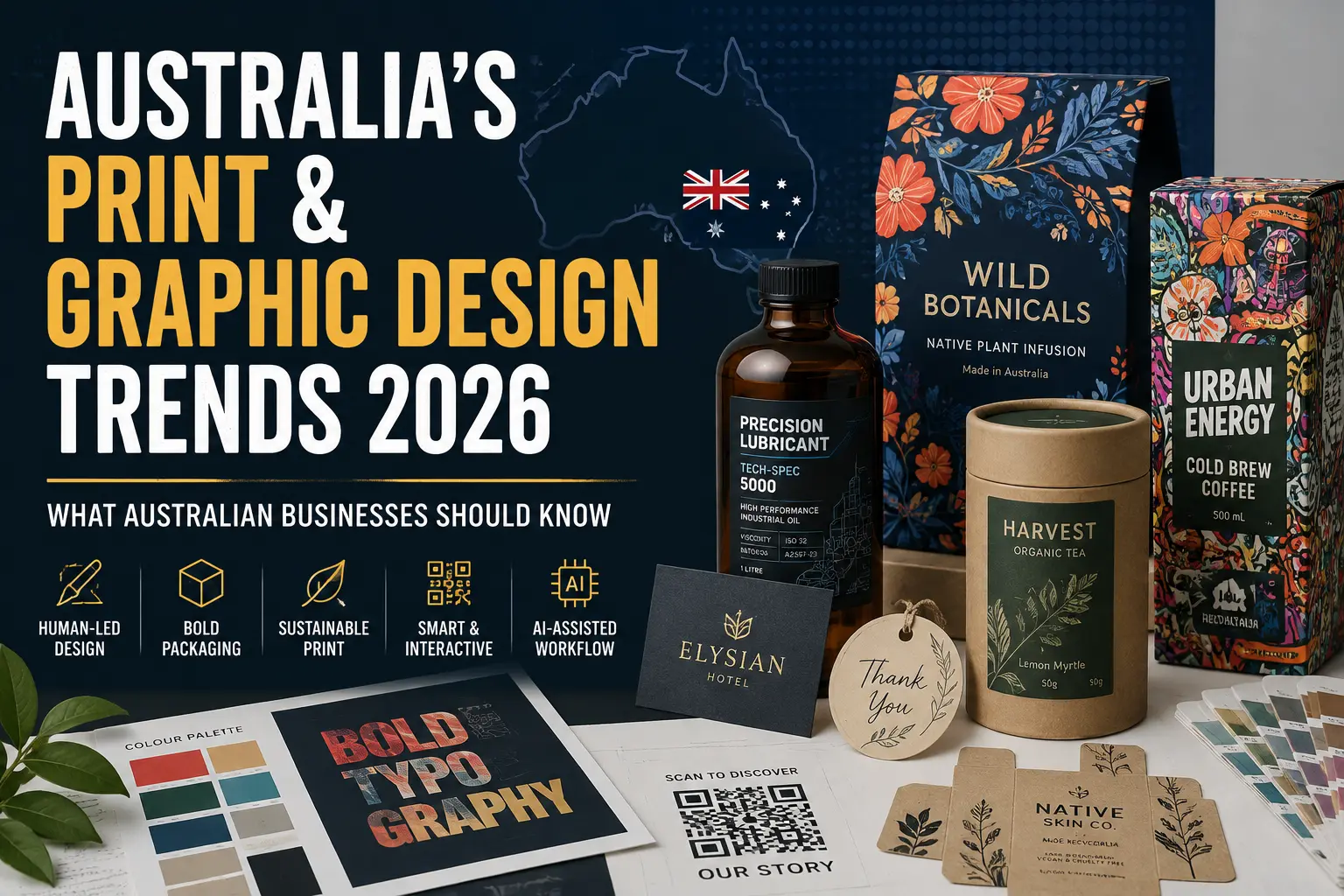

Australia’s Print & Graphic Design Trends in 2026: What Businesses Should Know
The way Australian businesses use Graphic Design is changing.
For a long time, digital marketing was seen as the centre of branding, while printed materials were treated as something secondary. But in 2026, print is finding a different role. Packaging, labels, brochures, business cards, signage and other printed materials are becoming important touchpoints in the customer experience.
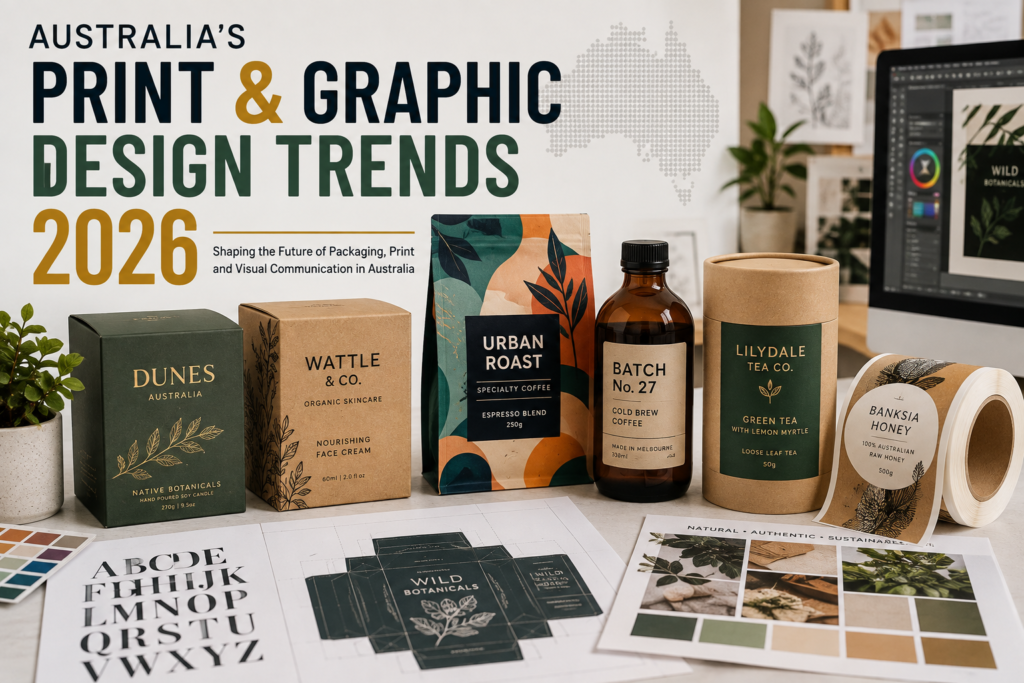
At the same time, graphic designers and printers have more technology available than ever before. Digital printing, short-run production, personalisation, improved finishing techniques, automation and AI-assisted design are making it easier for businesses to produce professional printed materials without relying only on large production quantities.
This is creating an interesting mix of old and new.
Customers are responding to designs that feel human, tactile and distinctive, while businesses are looking for faster, more flexible and cost-effective production.
Here are some of the print and graphic design trends worth watching in Australia in 2026.
1. Imperfect Human Design
One of the most interesting changes in graphic design is the return of the human touch.
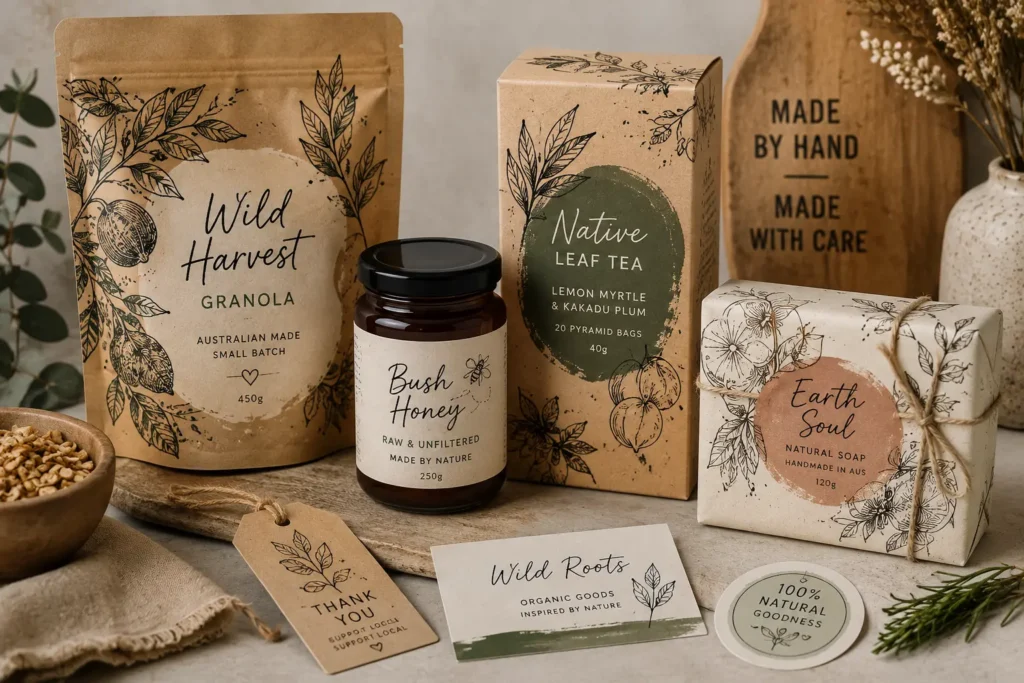
Perfect geometric layouts and highly polished digital graphics still have their place, but many brands are deliberately introducing hand-drawn elements, rough textures, irregular lines and slightly imperfect typography.
Why?
Because perfect design can sometimes feel distant.
A hand-drawn illustration or unusual letterform can make a package feel more personal. It can suggest craftsmanship rather than mass production.
This style works particularly well for food brands, cafés, local producers, handmade products, hospitality businesses and lifestyle brands.
The important thing is that the imperfection should look intentional. It should communicate personality without making the final artwork look unfinished.
For printers, this trend also creates opportunities to use textured papers, natural-looking materials, embossing and other physical finishes that support the handmade character of the design.
2. Chaos Packaging and Maximalism
Minimal packaging has dominated shelves for years. Clean layouts, large areas of white space and simple typography have become familiar.
In 2026, some brands are moving in the opposite direction.
Maximalist packaging uses strong colours, oversized typography, illustrations, patterns and multiple visual elements to create immediate attention.
This doesn’t mean putting everything on the package without a plan.
Good maximalism is controlled.
The customer should still be able to identify the brand and understand the product quickly. The visual complexity is used to create personality and shelf impact, not confusion.
For smaller Australian brands competing against larger companies, this can be particularly useful. A distinctive package can help a new product look different from competitors using predictable visual styles.
Print techniques such as foil, spot UV, unusual die cuts and specialty papers can take this approach even further.
3. Elemental Folk and Heritage Design
Modern branding is also looking backwards for inspiration.
Traditional illustration, folk patterns, engraving, botanical artwork, vintage typography and heritage-style graphics are appearing in contemporary packaging and branding.
The interesting part is that designers are not simply recreating old labels.
Instead, they are taking familiar visual ideas and giving them a modern treatment.
This can work especially well for Australian businesses with a strong connection to local production, regional identity, food, beverages, craft and hospitality.
“For these businesses, thoughtful packaging design can help turn heritage and local identity into a strong visual brand experience.”
A heritage-inspired label can make a product feel established and authentic, even when the company itself is relatively new.
Detailed line illustrations, limited colour palettes and textured paper can reinforce this impression.
The combination of traditional-looking artwork with modern printing technology creates a particularly interesting result.
4. Micro-Industrial and Tech-Spec Design
Not every brand wants to look warm and handcrafted.
For technology, engineering, automotive, tools, manufacturing and industrial businesses, a more technical visual language can communicate precision and reliability.
This is where Micro-Industrial and Tech-Spec design comes in.
Think structured grids, specification-style information, technical diagrams, numbers, symbols, measurement marks and strong functional typography.
The style can make packaging feel engineered rather than decorative.
It is also useful when a product has technical information that needs to be communicated clearly.
A good technical design doesn’t hide information behind decoration. It organises information so that the customer can understand it quickly.
This approach can be especially effective for Australian manufacturers and businesses selling specialised products where trust and precision are important.
5. Typography Takes the Lead
Typography is becoming a much stronger visual tool.
Instead of using text simply to explain a product, designers are increasingly turning the product name or a single word into the main visual element.
Large lettering can make a poster, box, label or promotional piece instantly recognisable.
This is particularly useful in retail environments where people may only have a few seconds to notice a product.
Bold typography doesn’t necessarily mean using a huge font everywhere. It means giving typography enough visual importance to carry the design.
Custom lettering, unusual typefaces, condensed fonts and expressive layouts can give a brand a distinctive voice.
For print, large typography also creates opportunities for embossing, foil, raised finishes and other treatments that make words physically noticeable.
6. Texture Is Becoming a Design Tool
Screens are smooth.
Print doesn’t have to be.
One of the advantages physical communication has over digital media is the ability to create a tactile experience.
A customer can feel textured paper, raised lettering, embossing or a soft-touch coating.
This is why premium print finishing remains important.
Businesses can use:
- Embossing
- Debossing
- Foil stamping
- Spot UV
- Soft-touch coatings
- Textured stocks
- Metallic papers
- Specialty finishes
These details can be particularly effective for cosmetics, premium food and beverages, hotels, restaurants, professional services and luxury products.
The goal isn’t to add every available finish.
One well-chosen tactile detail can often create a stronger result than several competing effects.
7. Sustainable Print Becomes More Practical
Sustainability continues to influence packaging and print, but the conversation is becoming more practical.
Using green colours and leaf graphics is not enough to make a package sustainable.
Businesses are looking at the materials themselves, the amount of packaging used, recyclability, production processes and how easily packaging can be handled after use.
For designers, this means sustainability needs to be considered before the artwork reaches the printer.
A design may look excellent on screen but require unnecessary material, complicated finishing or difficult production.
A better approach is to think about the complete process.
Can the packaging use less material?
Can the design work with recyclable stock?
Can unnecessary layers or finishes be removed?
Can the artwork be produced efficiently?
Good sustainable design is not about making a package look “eco”.
It is about making better decisions throughout the design and production process.
8. Short-Run Digital Printing
Large print quantities are no longer the only practical option.
Digital printing has made smaller production runs much more accessible, which is particularly useful for Australian small businesses and growing brands.
A business may want only a few hundred labels for a new product rather than thousands.
It may also need different versions for different products, locations or campaigns.
Short-run printing makes these projects easier to manage.
It can also reduce the risk of ordering a large quantity of packaging before a product has been properly tested in the market.
This is particularly useful for:
- Start-ups
- Small food businesses
- E-commerce brands
- Seasonal products
- Limited editions
- Promotional campaigns
- New product launches
The design process therefore needs to become more flexible.
Instead of creating one artwork file that can never change, designers can build systems that allow product names, colours, sizes and other information to be updated efficiently
9. Personalised Packaging and Labels
Personalisation is moving beyond digital advertising.
Printed materials can also be customised.
Different customer groups, product variants, seasonal campaigns and promotional editions can all use slightly different printed materials.
For example, a beverage company could produce different labels for several flavours while maintaining the same overall brand identity.
An e-commerce business might create limited-edition packaging for a particular campaign.
This type of flexibility is one reason digital printing is becoming increasingly useful for modern brands.
The challenge for designers is maintaining consistency.
Personalisation should make the customer feel that the product is special without making the brand identity disappear.
10. Print and Digital Are Working Together
Printed materials are no longer isolated from digital marketing.
A package can lead a customer directly to a website.
A brochure can connect to a product video.
A label can include a QR code.
A business card can send someone directly to a booking page or portfolio.
This makes printed communication much more useful.
Instead of trying to put every piece of information on a physical surface, designers can keep the printed design clean and use technology to provide additional information.
QR codes, for example, can connect customers to tutorials, recipes, product information, reviews, promotions or loyalty programs.
The important part is integration.
A QR code should have a reason to exist. Simply adding one to a package does not automatically create a better customer experience.
11. AI Is Changing the Design Workflow
AI is becoming part of the graphic design and print production process.
Designers can use AI tools to explore concepts, create variations, generate visual references and speed up repetitive tasks.
But AI is not replacing the fundamentals of good design.
A successful printed product still needs appropriate typography, colour management, hierarchy, layout, image quality and production knowledge.
“This is why professional print-ready artwork remains an important part of the production process.”
There is also an important difference between creating something that looks good on a screen and creating artwork that can actually be printed correctly.
Bleed, resolution, colour profiles, vector artwork, dielines, trapping and finishing requirements still matter.
The strongest workflow is therefore likely to combine AI-assisted exploration with human creative direction and professional print preparation.
12. Packaging Is Becoming Part of the Customer Experience
Perhaps the biggest change is that packaging is no longer being treated simply as protection for a product.
It is part of the brand experience.
The customer sees the package before using the product.
They may photograph it.
They may share it online.
They may keep part of it.
They may remember the visual design when making their next purchase.
This means designers need to think about the complete experience.
What does the customer see first?
What does the package feel like?
What happens when it is opened?
Is the information easy to understand?
Does the design feel consistent with the website and social media?
Does the package look like the brand?
These questions are becoming just as important as the choice of colours or fonts.
What These Trends Mean for Australian Businesses
Australian businesses don’t need to follow every design trend.
In fact, following every trend can make a brand look confused.
The better approach is to identify which trends actually support the business.
A premium skincare brand might benefit from tactile finishes and restrained typography.
A local food producer might use heritage illustration and textured materials.
A technology company could use technical layouts and structured typography.
A small e-commerce business might benefit more from short-run printing and personalised packaging.
An artisan brand could combine hand-drawn artwork with modern digital printing.
The trend should serve the brand, not the other way around.
The Future of Print in Australia
The future of print isn’t simply about producing more printed materials.
It is about making each printed piece more useful, more memorable and more connected to the customer.
Human-looking design is meeting advanced production.
Heritage aesthetics are meeting digital printing.
Physical packaging is meeting QR technology.
Short-run production is meeting personalisation.
And traditional graphic design is increasingly working alongside AI-assisted tools.
That combination creates a lot of opportunities for Australian businesses.
For designers and printers, the challenge is to balance creativity with production reality.
A design needs to look good on a screen, but it also needs to work on paper, cardboard, labels, signage or whatever physical material the customer will actually receive.
Final Thoughts
The strongest print and graphic design trend in Australia for 2026 may not be one particular colour, font or packaging style.
It is the growing importance of purposeful design.
Businesses want printed materials that feel distinctive without being wasteful, premium without being unnecessarily complicated, and modern without losing their human character.
For designers, this means understanding more than aesthetics.
It means understanding the brand, the customer, the material, the printing process and the final physical experience.
That is where good graphic design becomes valuable.
Because ultimately, great print design isn’t just something people look at.
It is something they notice, touch, remember and experience.
Looking for Print-Ready Graphic Design?
At Shranira, we help businesses and print professionals with graphic design, packaging, branding and production-ready artwork.
Our services include packaging design, label design, print-ready artwork, vector artwork, raster-to-vector conversion, logo design, brochures, marketing materials, product mockups and other graphic design requirements.
If you’re launching a product, updating your packaging or preparing artwork for print, the right design can make the difference between something that simply gets printed and something that actually gets noticed.